INSTALLATIONS
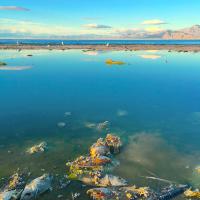
Salton Sublime
Audiovisual installation
7 minutes
2017
February 2017 Ohrenhoch Gallery ohrenhoch.berlin
March 2017, Off-Screen Festival , CAMRA at PENN, Phiadelphia, PA
JUNE 3, 2017 soundpedro.org Angels Gate Cultural Center, San Pedro, CA
August 2017 Miami Independent Film Festival, (MINDIE) Miami, FL
Poets and painters of the 18th century sought a religious experience in the sublime continence of nature. They enjoyed meditating on the beauty of nature's danger and the inherent tension and possibility it always offered of sudden and assured death - as a result for example, of a fall from a high cliff, a storm at sea, a volcano's eruption or chasm opening in the earth to swallow one whole. They also meditated on the vastness, infinity, magnificence and the resulting exultation, the possibility of being raised up, temporarily overwhelmed in a spiritual sense and being made to feel small in the face of overwhelming emotion and the awe which nature can inspire. This transcendental desire has humans seeking a god or something greater in nature. Salton Sublime meditates on the meaning of sublime today in the midst of massive environmental degradation. The Salton Sea in southern California brings a whole new meaning to the sublime as it contains both the awe-inspiring possibilities of a spiritual experience as well as terror and abject fear - especially of death. This project is a remnant of that same heritage of sublime art that seeks to engage the beauty and the terrifying danger of nature while examining both our reliance on and abuse of nature... it asks, what is ultimately left of the sublime? Can we inspire awe from terror?
 |
FUZUL, 3:18 minutes, 2016 Audio story in Zoya Sardashti’s curated The Future of Iranian Theatre, Curative Archive [info] |
|
I can’t think of an initial inspiration, inspire is to breathe and I was born with a questioning, fuzul, mind. I’ve always asked a lot of questions and when it comes to relaying the information I collect, my aesthetic tends more toward a fragmented visual, narrative, sound-scape form that might be as easily defined as art as it is science. Even when as an anthropology doctoral student, I was trying to do straight ethnography my mentors recognized what I was doing as some sort of artistic practice, so it’s more of an innate predilection than a choice. But when it comes to choosing what to do with the information I collect I choose always a more “artistic” output, because that’s the kind I’m more receptive to as a consumer…I’d rather read a novel, look at a painting, watch a play than read an academic article. I wholeheartedly believe we need to examine life, to collect data and learn, to understand deeply where we are and what is at stake – to see reality and understand it, but then we also have the responsibility to create, to change, to make our own, hopefully better reality. Roxanne Varzi |
||
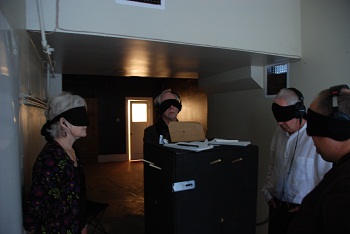 |
WHOLE WORLD BLINDSound installation, 2011MP3, blindfolds9 minutesLISTEN HERE |